Table of Contents
Why Patients do not Show Up, And Why it is Rarely About the Care
Where Patient Communication Actually Breaks Down
What a Healthcare CRM Actually Does for Appointments and Follow-ups
Building a Patient Follow-Up System That does not Depend on Memory
How This Plays Out Across Different Kinds of Practices
A patient calls to book a consultation, the front desk notes it down, and the appointment goes into a register or a shared spreadsheet. Two days later, the patient did not show up. Nobody called to remind them. Nobody knows why they did not come. And the slot that could have gone to someone else sat empty.
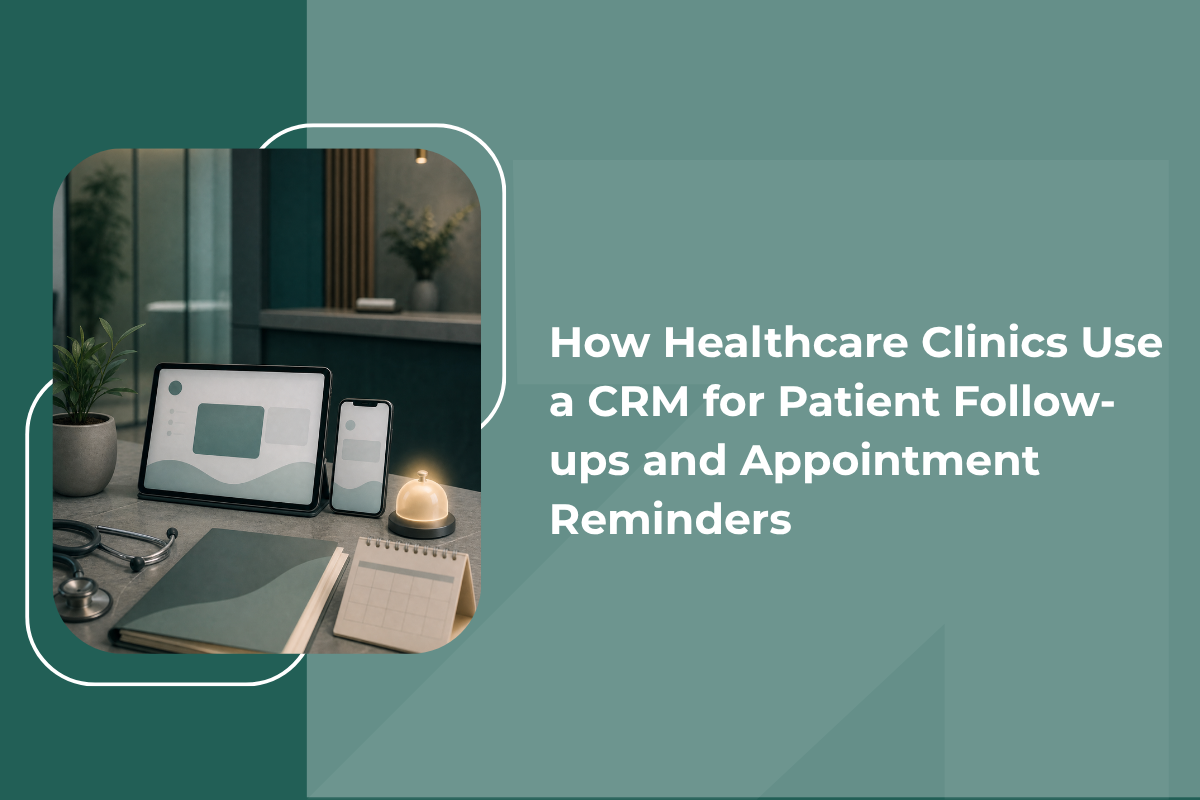
This happens in clinics and hospitals every single day, and it isn't a staffing problem or a care-quality problem, it is a communication problem. This blog looks at how healthcare providers actually use a CRM to fix it: automating appointment reminders, keeping post-visit follow-ups from being forgotten, and turning a one-time patient into someone who keeps coming back.
Why Patients do not Show Up, And Why it is Rarely About the Care
Ask most clinics why a patient missed an appointment and the honest answer is usually: nobody knows. The patient wasn't reminded, forgot about it entirely, or had a scheduling conflict they never got the chance to flag because there was no easy way to reschedule. Very rarely is it because they lost faith in the doctor or the treatment.
No-show rates in outpatient settings commonly run in the 25–30% range when reminders are inconsistent or manual, a huge share of booked capacity that simply evaporates, along with the staff time spent scheduling those slots in the first place. Every no-show is also a missed opportunity for genuine care: a patient who needed a follow-up scan, a review of test results, or a routine check that just never happened.
The fix isn't convincing patients to care more. It is making sure they're reminded automatically, consistently, and through a channel they'll actually see, which, for most patients, is a WhatsApp message rather than a call that goes to voicemail or an SMS that gets lost in a pile of promotional texts.
Where Patient Communication Actually Breaks Down
A few recurring failure points show up across clinics of every size:
- Reminders depend on someone remembering to send them - Reminders depend on manual staff effort: Relying on front-desk memory or tracking appointments in shared spreadsheets inevitably leads to missed reminders the moment the clinic reception gets crowded.
- Follow-ups after a visit rarely happen at all - A patient sees a doctor, gets a prescription or a treatment plan, and then hears nothing until their next self-initiated visit, even though a simple check-in a day or two later, or a nudge for a recommended follow-up test, meaningfully improves both outcomes and retention.
- No-shows do not trigger any response - When a patient misses an appointment, most clinics simply move on to the next patient rather than reaching out to understand why and offer to reschedule, quietly losing a patient who may have simply had a conflict, not lost interest in care.
- Enquiries from different channels do not land in one place - A patient might call, message on WhatsApp, fill a form on the clinic's website, or walk in directly, and without a system pulling all of these into a single record, the same patient can end up being treated as several different, disconnected contacts.
- Context gets lost between visits - When a patient calls back, whoever picks up often has no visibility into what was discussed last time, what was prescribed, or what follow-up was recommended, forcing the patient to repeat their history and making the interaction feel impersonal.
What a Healthcare CRM Actually Does for Appointments and Follow-ups
A CRM built for healthcare centralises every patient interaction, website enquiries, WhatsApp messages, phone calls, and walk-ins, into one record per patient, and automates the communication around it rather than leaving it to staff memory.
- Appointment booking and confirmation - The moment an appointment is booked, whether by a staff member or through an online enquiry, a confirmation goes out automatically over WhatsApp with the date, time, doctor, and directions, removing the need for a manual confirmation call.
- Automated reminders at the intervals that matter - Reminders typically go out at two points, roughly a day before the appointment, and again a couple of hours before, without any staff involvement. This two-touch reminder pattern is the single biggest lever for reducing no-shows, and clinics using it consistently see no-show rates drop dramatically, in some cases from the 25–30% range down to under 5% within the first month of consistent use.
- Automatic no-show follow-up - If a patient does not arrive, the system does not just move on, it can automatically send a WhatsApp message offering to reschedule, catching a patient who may have simply had a last-minute conflict before they drift away from the practice entirely.
- Post-visit follow-up sequences - After a consultation, a check-in message can go out within a day; after a procedure, recovery instructions can be sent automatically; for patients on ongoing medication, reminders can fire on a set schedule; and for anyone due for a routine return visit, reminders fire automatically. Configuring these automated follow-up workflows ensures patient post-care routines run on time without burdening clinic staff.
- A 24×7 AI voice agent for after-hours enquiries -Patient enquiries do not stop when the front desk closes. An AI voice agent can answer calls after hours, confirm availability, and book appointments directly, so a patient calling at 9 PM to book tomorrow's slot does not have to wait until morning for a callback.
- Every call logged automatically, with a summary - Modern AI calling CRM systems automatically record and summarize every patient phone consultation, logging key health notes and required next steps directly to the patient's electronic file.
Building a Patient Follow-Up System That does not Depend on Memory
The technology matters, but so does the structure behind it. A workable patient follow-up system generally has a few consistent elements:
- Every enquiry gets captured the same way, regardless of source - Whether a patient calls, messages, or books online, it should land in the same system as a single record, not scattered across a register, a WhatsApp inbox, and a spreadsheet.
- Reminders are automatic, not optional - Every booked appointment should trigger the same reminder sequence by default, so consistency does not depend on which staff member is on shift that day.
- Follow-up cadence is defined per visit type not generic. A post-surgical check-in, a routine consultation follow-up, and a chronic-condition medication reminder all need different timing, building this once into the system means it runs correctly for every patient without a staff member deciding case by case.
- Every conversation is logged against the patient, so any staff member, not just the one who originally spoke to them, can pick up a call with full context.
Once this is in place, staff time shifts from chasing reminders and rebooking no-shows toward the things that actually need a human, handling in-clinic patients, answering clinical questions, and managing the cases that need real judgment.
How This Plays Out Across Different Kinds of Practices
The same underlying system applies differently depending on the type of practice:
- Multi-specialty hospitals deal with enquiry volume across many departments at once. Automating confirmation and reminders means front-desk staff aren't manually calling every patient across every department, and managers can see appointment and no-show trends by specialty rather than guessing.
- Single-specialty clinics, dermatology, orthopaedics, cardiology, benefit from consistent post-visit follow-up and review collection, since a single missed follow-up is a bigger relative loss for a smaller practice than for a large hospital.
- Diagnostic and lab centres have a slightly different rhythm: confirming sample collection times, sending a WhatsApp alert the moment a report is ready rather than making the patient call to check, and automatically nudging for the next scheduled test cycle.
- Dental clinics rely heavily on recall, the six-month cleaning reminder, the pre-procedure instructions, the post-procedure check. These are exactly the kind of interval-based reminders that are easy to automate and easy to forget manually.
- Pharmacies and wellness chains use similar automation for refill reminders and health camp promotion, treating patient outreach as an ongoing relationship rather than a one-off transaction.
- Mental health and therapy practices need a more discreet touch, session reminders and gentle no-show follow-ups that respect the sensitivity of the context, which a well-configured CRM can handle through tone and template choice rather than a one-size-fits-all message.
Choosing the Right CRM for Your Practice
Not every CRM on the market is built with healthcare-specific realities in mind, appointment-based scheduling, high enquiry volume, and WhatsApp as the primary patient communication channel in India. Many enterprise healthcare CRM tools are built for large hospital systems, requiring IT teams and months of setup before they're usable, overkill for a clinic or a growing practice that needs to be live in days, not quarters.
When evaluating a healthcare CRM, the features that make the most practical difference are: native WhatsApp reminders (not a bolted-on integration), automatic no-show follow-up, post-visit automation that can be configured per visit type, and a 24×7 booking option for enquiries that come in outside clinic hours.
GrowEasy's healthcare CRM is built specifically around this workflow, multi-channel enquiry capture, automated WhatsApp reminders sent 24 hours and 2 hours before every appointment, automatic no-show follow-up, and a 24×7 AI voice agent that can book appointments after hours. It is designed to go live in around 5 days without needing an in-house IT team, with WhatsApp CRM, AI voice agents, and CRM automation working together so a solo practitioner or a multi-location hospital group can run the same reliable follow-up system without manually managing it. If your practice is currently relying on a register or a shared spreadsheet to track patients, it is worth reading about why leads go cold and how lead management software fixes it. The same underlying process failures that lose sales leads are what quietly lose patients too.
Reducing no-shows and keeping follow-ups consistent isn't about hiring more front-desk staff or asking patients to be more responsible. It is about building a system where the reminder, the follow-up, and the next appointment nudge happen automatically, every time, regardless of how busy the clinic gets on any given day.
Frequently Asked Questions
How much can a CRM actually reduce no-shows?
Clinics using consistent, automated WhatsApp reminders, sent roughly 24 hours and again a couple of hours before the appointment, commonly see no-show rates drop from the 25–30% range down to under 5% within the first month of use. The two-touch reminder pattern is the single biggest factor, since it catches patients who forgot as well as those who need a last-minute nudge.
Does a small clinic really need a CRM, or is this only useful for hospitals?
A CRM benefits practices of any size. A solo practitioner managing a few dozen patients a week faces the same underlying problem as a large hospital managing thousands, reminders and follow-ups that depend on staff memory do not scale reliably, even at a small scale. The value shows up early, not just after a practice grows large.
How does a CRM handle patient communication outside clinic hours?
A 24×7 AI voice agent can answer enquiry calls after hours, confirm doctor availability, and book appointments directly, so a patient calling in the evening does not have to wait until the next morning for a callback, and the practice does not lose the enquiry to a competing clinic that responds faster.
What happens when a patient misses an appointment?
Rather than simply moving on, an automated system can trigger a WhatsApp follow-up offering to reschedule the moment a no-show is detected. This catches patients who had a genuine conflict rather than losing them silently, and keeps the appointment slot recoverable.
Can post-visit follow-up be different for different types of visits?
Yes, a well-configured healthcare CRM lets a practice define different follow-up sequences by visit type: a check-in after a routine consultation, recovery instructions after a procedure, ongoing medication reminders for ongoing care, and next-appointment nudges based on the recommended return interval. Each runs automatically once configured, without a staff member deciding case by case.
How long does it take to get a healthcare CRM up and running?
Setup timelines vary by platform, but purpose-built healthcare CRM software is generally designed to go live within about 5 days, including configuration of departments, doctors, and schedules, a significantly shorter timeline than enterprise systems that can take months and require dedicated IT support.