Table of Contents
Why Seasonal Spikes Are So Damaging for Travel Agencies
What Actually Happens During a Lead Spike Without a System
How a Travel CRM Handles the Spike?
Building a Peak-Season Process That Holds Up
Handling Different Kinds of Travel Business During Peak Demand
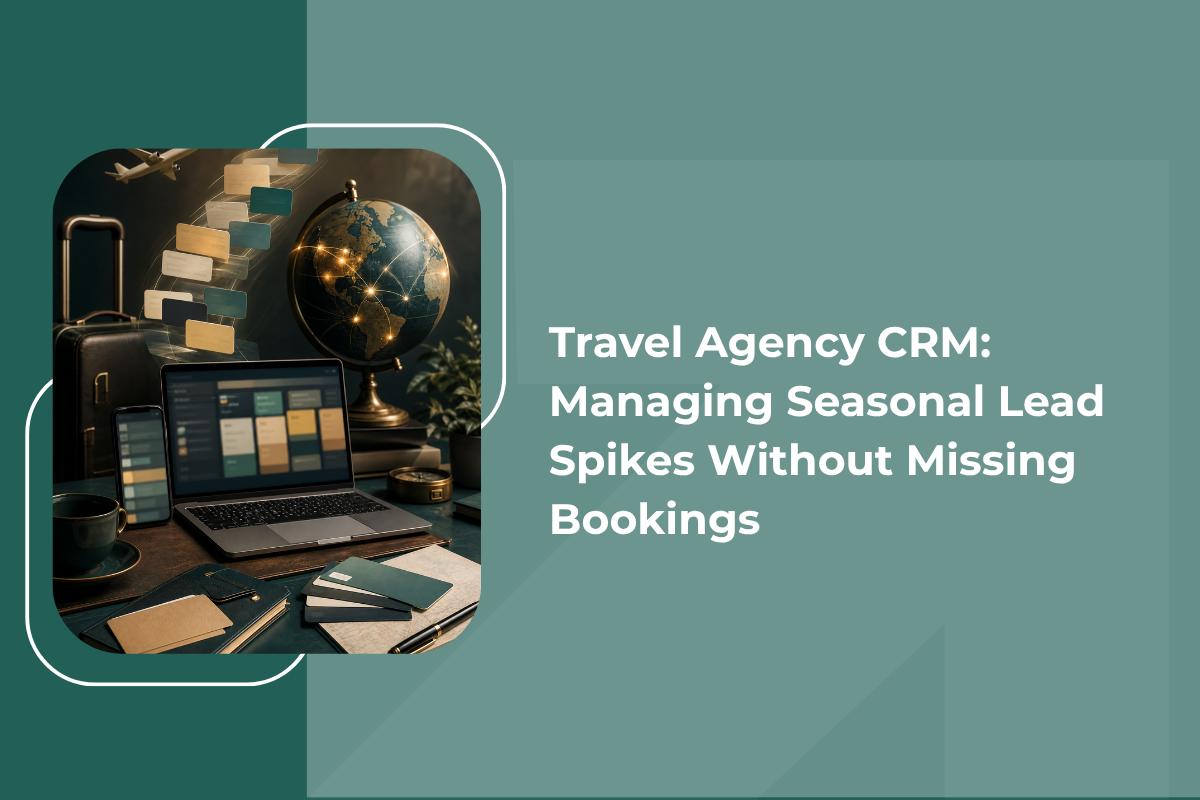
Every travel agency knows the pattern. For weeks, enquiries trickle in at a manageable pace. Then a long weekend gets announced, summer break approaches, or a destination starts trending, and enquiries triple or quadruple almost overnight. The same small team that comfortably handled twenty enquiries a week is suddenly facing eighty, and the cracks start showing immediately, slower responses, missed follow-ups, and travellers who book with a competing agency simply because they replied faster.
This is the defining operational challenge for travel agencies and tour operators: the business is inherently seasonal, but the cost of a slow response does not take a season off. This blog looks at how a travel CRM helps agencies handle these spikes without losing bookings to whoever answers the WhatsApp message first.
Why Seasonal Spikes Are So Damaging for Travel Agencies
Travel is one of the most seasonally concentrated categories in consumer spending. Summer holidays, festive long weekends, wedding season honeymoon bookings, and year-end holiday travel all compress a large share of annual enquiry volume into a handful of short windows. An agency's staffing, by contrast, is usually built for average demand, not peak demand; hiring a full team sized for the busiest three weeks of the year rarely makes financial sense.
This mismatch means the exact moments when an agency has the most opportunity to book revenue are also the moments when its ability to respond quickly is most strained. And in travel specifically, response speed is unusually decisive: a traveller planning a Maldives trip or a Europe holiday is very rarely enquiring with only one agency. Multiple WhatsApp messages and phone calls typically go out to several agencies at once, and the booking generally goes to whichever agency sends a compelling itinerary and follow-up first, not necessarily whichever has the best package.
What Actually Happens During a Lead Spike Without a System
Without a system built for volume, a few predictable failures show up during peak season:
- Enquiries get acknowledged late, or not at all - When forty enquiries arrive in a single day across Facebook messages, WhatsApp, phone calls, and a contact form, it is easy for several to simply sit unanswered while staff work through the ones they noticed first.
- Follow-up falls apart entirely - Even if the first response goes out reasonably fast, the second and third touchpoints, sharing a revised itinerary, checking if the traveller has decided, nudging toward payment, are the ones that get dropped when volume is high, and these are often the touchpoints that actually convert a browsing enquiry into a booking.
- High-intent travellers get the same treatment as casual browsers - A family that has already shared their budget, travel dates, and group size is a very different opportunity than someone who asked a single vague question, but without a way to distinguish them, both can end up waiting the same amount of time for a response.
- Agents lose track of who they've already spoken to - When the same enquiry comes in through two channels, say, a Facebook ad click and a follow-up WhatsApp message, it can get treated as two separate leads, leading to duplicated or inconsistent outreach that looks disorganised to the traveller.
- Managers have no visibility into what's actually happening - During the busiest period of the year, when oversight matters most, managers are often the least able to see which enquiries are being handled well and which are quietly slipping through, because everything is happening across individual staff members' phones and inboxes.
How a Travel CRM Handles the Spike?
A CRM built for travel agencies is designed specifically to absorb this kind of volume surge without the process breaking down.
- Every enquiry is captured automatically, from every source - Facebook ads, Google, travel portals, WhatsApp, and website enquiries all flow into a single dashboard the moment they come in, so nothing depends on a staff member manually checking multiple inboxes during the busiest days of the year.
- An instant WhatsApp response goes out before a human even sees the enquiry - A personalised WhatsApp message with initial itinerary options can be triggered automatically within roughly 60 seconds of an enquiry coming in, often before a competing agency has even opened the message, let alone replied.
- AI scores every enquiry by intent, so agents know who to call first - By reading signals like destination, budget, group size, and travel dates, the system can automatically flag a traveller as Hot, Warm, or Cold, meaning a family with confirmed dates and a clear budget gets prioritised over someone who sent a single exploratory message, rather than both sitting in the same queue.
- AI follows up around the clock, even when the team is offline - Since travel enquiries don't stop at 7 PM, an AI voice agent and automated WhatsApp sequences can continue following up on enquiries overnight, sharing itinerary options, collecting travel dates, and nudging toward a decision, so agents come in each morning to a pipeline of travellers who are already warmed up, rather than a backlog of untouched messages.
- Every call is logged automatically with a summary - When an agent does call a traveller, the conversation, destination discussed, budget confirmed, travel dates, any visa questions, is automatically logged, so a follow-up call by anyone on the team starts with full context instead of asking the traveller to repeat themselves.
- A visual pipeline shows exactly where every booking stands - Enquiry → Itinerary Sent → Quote Accepted → Payment → Confirmed, with every traveller's stage visible at a glance, it becomes immediately obvious which bookings are close to closing and need urgent follow-up, and which are still early-stage.
- Managers get real-time visibility without asking for updates - During peak season specifically, this matters most: a manager can see every agent's enquiry load, response times, and bookings in progress live, and step in, reassigning enquiries or flagging a stalled conversation, before an opportunity is lost, rather than finding out about a missed enquiry after the traveller has already booked elsewhere.
Building a Peak-Season Process That Holds Up
Technology alone does not solve a seasonal spike, it needs a process built around it. A few practices that make the biggest difference:
- Automate the first response by default, so speed does not depend on staff availability during the busiest hours of the day.
- Prioritise by intent and not by order received. A high-budget, confirmed-dates inquiry sitting for an hour is a bigger loss than a vague one-line question sitting for the same hour, a system that scores and surfaces the highest-intent enquiries first prevents agents from working through the queue in the wrong order.
- Pre-build itinerary templates for your top seasonal destinations before the spike hits, so the AI and your agents can send a compelling, personalized-feeling response instantly rather than building one from scratch under time pressure.
- Set a fixed follow-up cadence for every stage of the booking pipeline, for example, a nudge two days after an itinerary is shared, and again if a quote hasn't been accepted within a week, so momentum does not depend on an individual agent remembering to check back in.
- Review pipeline health daily during peak weeks, not just at the end of the month, so a manager can catch enquiries that are stalling while there's still time to recover them.
The goal isn't to handle every enquiry personally and immediately, during a genuine spike, that's simply not realistic for most teams. The goal is to make sure no enquiry goes completely unacknowledged, and that the highest-intent travellers get the fastest, most attentive follow-up.
Handling Different Kinds of Travel Business During Peak Demand
The shape of the spike looks different depending on what kind of travel business you run:
- Holiday and leisure package sellers see the sharpest volume swings tied to school holidays and long weekends. Automated itinerary sharing and group booking tracking matter most here, since families often need multiple back-and-forth rounds before committing.
- Corporate travel businesses face a different kind of surge, bulk, multi-traveller bookings around specific business periods, where invoice tracking and approval workflows matter as much as initial response speed.
- Pilgrimage and religious tour operators deal with concentrated demand around specific dates and often manage large groups at once, where visa and documentation tracking alongside WhatsApp group updates becomes the operational bottleneck rather than initial enquiry response.
- Honeymoon and special-occasion travel sellers deal with lower volume but higher personalisation expectations, automated systems here work best when paired with clear tracking of special requests, so automation handles the logistics while agents focus on the personal touches that this kind of booking depends on.
Choosing a CRM That's Actually Built for Travel
A generic sales CRM can technically store contact details and set reminders, but it typically has no concept of a travel-specific pipeline, no native WhatsApp integration, and no way to score a travel enquiry by destination, budget, and travel dates the way a travel-specific system does. For an industry where the buying conversation happens almost entirely over WhatsApp and calls rather than email, that gap matters enormously during peak season.
GrowEasy's travel agency CRM is built specifically around this workflow: multi-source enquiry capture from Facebook, Google, and travel portals, an automatic WhatsApp response within roughly 60 seconds of an enquiry, AI-driven traveller intent scoring, and a 24×7 AI voice agent that keeps following up on enquiries even when the team is offline. it is built on the same underlying lead management, WhatsApp CRM, and AI voice agent infrastructure used across GrowEasy's other high-volume, conversation-driven industries, and is designed to go live in around 5 days without requiring an in-house IT team, which matters when an agency needs a system ready before, not during, its next seasonal spike. If your team is currently relying on WhatsApp chats and a spreadsheet to track travel enquiries, it is worth reading about why leads go cold and how lead management software fixes it. The same process gaps that lose sales leads in any industry are what quietly cost travel agencies their busiest-season bookings.
Peak season will always be unpredictable in terms of exact timing and volume, but how an agency responds to it does not have to be. The agencies that consistently convert more of their seasonal spike into confirmed bookings aren't necessarily the ones with the biggest teams, they're the ones whose response speed and follow-up don't depend on how busy any single day happens to be.
Frequently Asked Questions
How much faster can a travel CRM actually respond to enquiries compared to a manual process?
Automated systems can send a personalised initial WhatsApp response within roughly 60 seconds of an enquiry coming in, compared to what is often several hours during a manual process at peak volume, a gap that frequently decides which agency gets the booking, since travellers commonly enquire with more than one agency at once.
Can a small travel agency benefit from this, or is it only useful for large tour operators?
Seasonal spikes hit small agencies just as hard, if not harder, since a small team has less slack to absorb a sudden tripling of enquiries. The core benefits, instant response, intent-based prioritisation, and automated follow-up, matter at any team size, and are often what allows a small agency to compete with larger operators during peak periods.
How does AI scoring actually decide which enquiries to prioritise?
The system reads details a traveller has already shared or that can be inferred from their behaviour, destination interest, stated or implied budget, travel dates, group size, and how actively they're engaging with shared itineraries, and uses these signals to flag enquiries as Hot, Warm, or Cold, so agents know who to call first instead of working through enquiries in the order they arrived.
What happens to enquiries that come in after office hours during peak season?
A 24×7 AI voice agent and automated WhatsApp sequences can continue engaging travellers outside working hours, sharing itinerary options, collecting travel dates, and nudging toward a decision, so an enquiry that comes in at 10 PM isn't simply waiting untouched until the next morning.
How does a manager keep visibility over a team during the busiest weeks of the year?
A real-time dashboard shows every agent's enquiry load, response times, and where each traveller sits in the booking pipeline, letting a manager spot a stalling or unassigned enquiry and intervene while there's still time to recover it, something that's very difficult to track manually once volume spikes.
How long does it take to set up a travel CRM before the next peak season?
Purpose-built travel CRM platforms are generally designed to go live in around 5 days, including configuration of enquiry sources, pipeline stages, and WhatsApp templates, which means an agency can realistically get a system in place well ahead of an upcoming seasonal spike rather than trying to fix the process mid-surge.