Table of Contents
The Reality of Running a Loan DSA Business
Why High Call Volumes Change Everything
What a Loan DSA CRM Actually Needs to Do
How to Manage Loan Leads Without Losing Track
How to Automate Loan Lead Follow-Up
How to Improve Loan Lead Conversion
Automated Lead Calling and Why It Matters for DSAs
The Business Impact of a Proper Lending CRM
As a Loan Direct Selling Agent, your day might start with a lead notification and end with a question about a payout. Before you have even had your first cup of tea, a new inquiry lands from a campaign. By mid-morning, a customer wants to know why their application is still under review. After lunch, a lender asks for one more document that somehow was not on the original checklist. Lastly, when the day seems to be settling down, an agent calls asking whether last month's commission has been credited.
In between all of this, you are juggling follow-ups, chasing documents, coordinating with multiple lenders, calming anxious customers, and trying to remember whether that personal loan file was logged yesterday or last week. At first it feels manageable; you tell yourself you will organise everything properly once things slow down, but that moment rarely arrives. This is exactly why loan DSAs need a CRM built for high call volumes, not a generic contact list borrowed from another industry.
The Reality of Running a Loan DSA Business
A Loan DSA rarely deals with one lender or one type of loan at a time. On any given day, you might be handling personal loan enquiries from a digital campaign, home loan referrals from a channel partner, and business loan leads from a walk-in customer, all while coordinating with three or four different lenders who each have their own document checklist, turnaround time, and approval process.
This is precisely why standard CRMs, designed for a single product and a single sales cycle, tend to fall short for DSAs. What a loan business actually needs is a system that understands multi-lender coordination, high-volume telecalling, and the document-heavy nature of loan processing, all built into one workflow rather than bolted on as an afterthought.
Why High Call Volumes Change Everything
Unlike many other sales businesses, loan sales run almost entirely on the phone. A single DSA might make anywhere from fifty to a few hundred calls in a day, following up on fresh leads, checking document status, confirming appointments, and chasing customers who have stopped responding.
Managing this volume with a personal phone and a notebook is not sustainable past a certain team size, and even a highly disciplined individual agent eventually starts missing calls, forgetting context from the last conversation, or losing track of who was called and when.
This is where telesales optimisation inside a CRM becomes essential rather than optional.
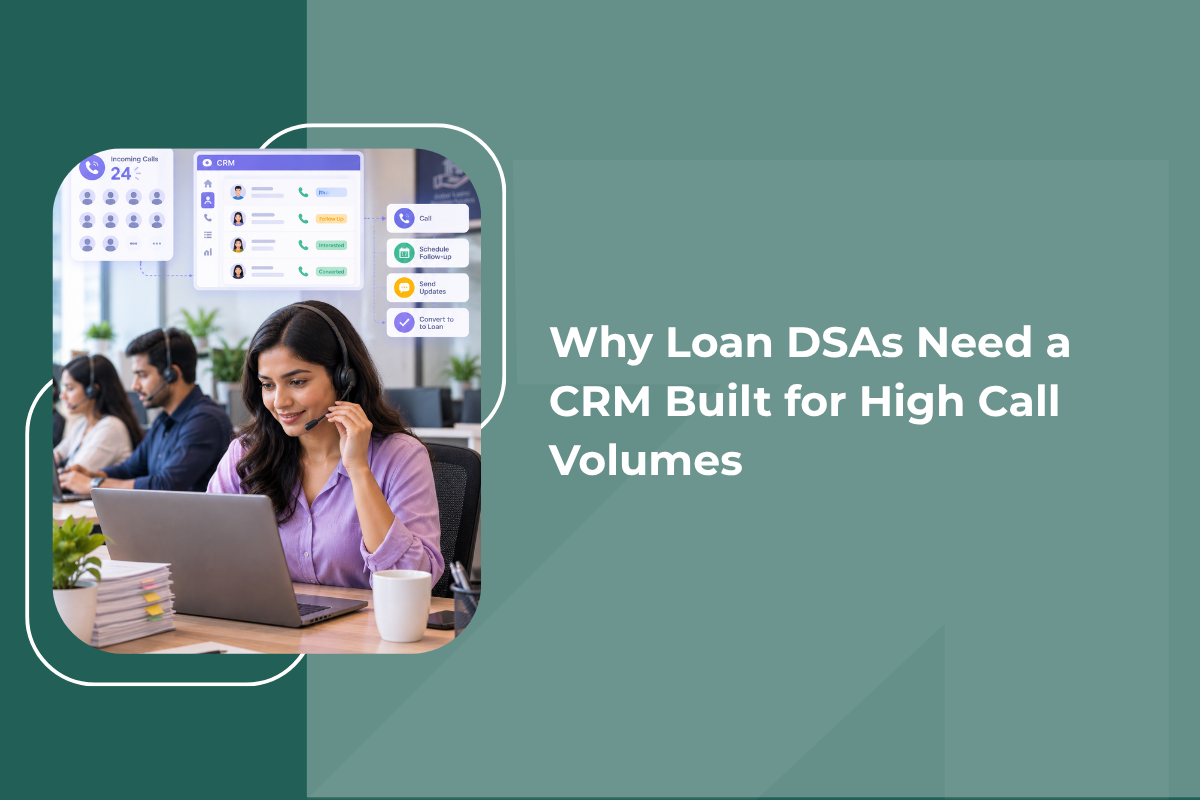
Features like a one-click dialer, automatic call logging, and performance tracking let a team turn calling into a measurable, improvable system instead of a chaotic, memory-dependent activity. A manager can monitor call outcomes, measure conversion rates by agent, and quickly identify which parts of the calling process need coaching.
What a Loan DSA CRM Actually Needs to Do
A CRM for loan DSA is essentially a system designed to manage the entire loan journey in one place while automating as many repetitive tasks as possible. A proper lending CRM supports the way DSAs actually work, rather than forcing them into a generic sales pipeline that does not match their reality. A few capabilities matter more than the rest.
Application capture that works from any source. Whether a lead comes from a landing page, a referral, a telesales call, or a field visit, the details should be recorded instantly inside the system with no retyping, no copy-paste errors, and no lost paper forms. This single habit ensures every enquiry enters the pipeline correctly from the very first moment.
Structured lead management. Every loan starts as a lead, and if leads are not organised properly, everything downstream begins to fall apart. A strong system captures leads from multiple sources such as campaigns, referrals, and walk-ins, automatically assigns each one to the right agent, tracks every lead stage by stage from new enquiry through to disbursal, and prevents duplicate entries that waste an agent's time calling the same person twice.
Automated follow-up reminders. In lending, timely follow-up is what actually closes deals. A CRM automatically sets reminders so hot leads never go cold, and agents receive notifications for pending calls and status updates, keeping the entire team consistent instead of relying on individual memory and enthusiasm.
One-click WhatsApp integration. Speed of communication can make or break a loan deal, since customers who do not hear back quickly often move on to another agent or another lender entirely. A CRM with built-in WhatsApp integration lets agents send messages directly from the dashboard without switching devices, and every message gets recorded automatically, keeping conversations organised and giving managers a complete communication history to review whenever needed.
Pre-screening tools. One of the biggest reasons loan files get rejected is that they should never have been submitted in the first place. Pre-screening capabilities let agents evaluate a borrower's eligibility before sending an application to a lender, checking income range, basic credit profile, and documentation readiness upfront, which filters out ineligible cases early and protects the DSA's approval ratio with each lending partner.
Secure document management. Loan processing runs entirely on paperwork, income proofs, KYC documents, bank statements, sanction letters, and without a proper system, these end up scattered across emails, WhatsApp chats, and local folders. A dedicated document management feature lets agents upload, store, and organise all required paperwork under each borrower's profile, and highlights missing or pending documents before a lender has to chase for them.
How to Manage Loan Leads Without Losing Track
Knowing how to manage loan leads properly starts with getting every enquiry into a single system the moment it arrives, regardless of the source. Instead of manually updating spreadsheets or scrolling through chat groups looking for a customer's last message, a good CRM gives you a complete pipeline view showing exactly how many leads are fresh, how many are in progress, and how many have already converted to disbursal.
From there, borrower segmentation becomes the next important step. Not every enquiry deserves the same level of attention or the same approach, so organising borrowers into clear segments based on income bracket, loan type, credit profile, or product interest lets a team prioritise high-potential borrowers, match customers with the most suitable lender faster, and personalise follow-ups instead of treating every lead identically. When you know exactly who your strong prospects are, you stop spreading the team's effort too thin across low-priority enquiries.
How to Automate Loan Lead Follow-Up
Learning how to automate loan lead follow-up is really about removing dependence on any single agent's memory or discipline. Once a lead enters the system, automated reminders should trigger at each stage of the process: a confirmation message when an enquiry is received, a reminder to call back if a lead has not been contacted within a set window, and a nudge if a document request has gone unanswered for more than a couple of days.
Template messages triggered by stage changes work particularly well here. A welcome message when a new lead comes in, a status update when an application moves to underwriting, and a check-in message if a case has been pending too long all keep the customer engaged without requiring an agent to draft and send each message individually.
This kind of automation does not replace the human relationship; it simply ensures that no customer is ever left wondering what is happening with their application.
How to Improve Loan Lead Conversion
Improving loan lead conversion comes down to combining speed, structure, consistency, and a CRM supports all three at once. Research across sales industries consistently shows that responding to a fresh enquiry within the first few minutes significantly increases the chance of conversion, and automated lead capture paired with instant assignment ensures no enquiry sits unattended simply because an agent was busy on another call.
Structured systems that track every lead properly and enforce consistent follow-up have been shown to meaningfully improve conversion rates compared to manual tracking, since no prospect is nurtured inconsistently or forgotten entirely.
Clear application tracking and organised document management also reduce loan processing delays considerably, which matters because a faster, more transparent process builds the kind of trust that leads a customer to actually complete their application instead of abandoning it halfway through.
Automated Lead Calling and Why It Matters for DSAs
For teams handling genuinely high call volumes, automated lead calling features such as a built-in dialer, automatic call logging, and click-to-call functionality remove a huge amount of manual friction from an agent's day. Instead of manually dialling numbers, searching for the right customer file, or scrambling to find notes from a previous conversation, an agent can call directly from the lead's profile inside the CRM, with the system automatically logging the outcome, duration, and any notes against that lead.
This does more than save time. It creates a reliable, searchable record of every conversation a customer has had with your business, which becomes invaluable the moment a different agent needs to step in, or when a manager wants to review exactly what was promised to a customer during a call. Over time, this record also becomes a powerful coaching tool, since a manager can identify patterns in calls that convert successfully versus ones that do not, and use that insight to train the rest of the team.
The Business Impact of a Proper Lending CRM
The benefits of moving to a structured lending CRM show up clearly across a DSA's entire operation. Agencies report meaningful reductions in loan processing time once application tracking and document management are centralized, since every stage becomes visible and files move faster instead of sitting idle waiting for someone to notice a missing document.
Centralising data and reducing manual coordination also cuts administrative workload considerably, freeing agents to spend more time handling the customers and closing deals rather than managing spreadsheets.
Commission visibility improves as well. With proper payout tracking built into the CRM, a DSA knows exactly which cases have been disbursed and how much commission is expected from each lender, which prevents revenue from slipping through the cracks and gives much greater financial clarity across the business as a whole.
Choosing the Right CRM for Your Loan Business
When evaluating a CRM for your loan DSA business, prioritise a platform that:
- Understands lender workflows: Look for a CRM that supports lender workflows, disbursal tracking, and commission calculations instead of a generic sales tool with a few custom fields.
- Handles document-heavy processes: The CRM should make it easy to manage and track documents without adding unnecessary steps.
- Supports multi-lender coordination: Choose a platform that can manage multiple lenders and their different processes without making workflows feel complicated or clunky.
- Manages high call volumes: Grow Easy's CRM for loan DSAs is designed around high-volume calling workflows, helping agents manage calls and follow-ups efficiently.
- Combines essential communication tools: Its dialer CRM, AI calling, and WhatsApp integration allow agents to call, log interactions, and follow up without switching between multiple tools.
- Helps manage business calls professionally: If your team still uses personal phones for work calls, explore the risks of using personal numbers for business.
- Improves calling efficiency: You can also explore how dialers increase calling efficiency to understand how automated calling tools can help agents save time.
A CRM for Loan DSA is not just software that stores contact numbers; it is the foundation of a scalable lending business. It brings structure to your leads, streamlines loan processing, secures your documents, and brings complete clarity to your commissions, all while handling the sheer call volume that defines this business every single day.
Today you may be managing fifty leads a month, and tomorrow that could easily be five hundred. The right CRM should grow with you without creating operational friction, so that as your business scales, your process feels more controlled rather than more chaotic. When your systems are strong, growth stops feeling like a constant firefight and starts feeling like something you can actually plan for.
If you want to see how a CRM built for high-volume calling and multi-lender coordination can help your loan DSA business, explore Grow Easy's pricing and plans to find a setup that fits your team.
Frequently Asked Questions
How many calls can a loan DSA team realistically handle with a proper CRM in place?
There is no fixed ceiling, but the difference is significant. Without a system, most agents plateau at a certain number of calls per day simply because they run out of mental bandwidth to track outcomes and plan follow-ups. With a dialer built into the CRM and automatic logging, agents spend far less time on admin between calls, so the same agent can handle a noticeably higher volume without sacrificing call quality.
Can a CRM really help with coordinating across multiple lenders at once?
Yes, and this is one of the areas where a lending-specific CRM shows its value most clearly. Instead of tracking each lender's requirements and turnaround times in separate notes or spreadsheets, a good CRM lets a DSA submit applications to multiple lenders, track each one's status independently, and see at a glance which lender is moving fastest on a particular case, all from a single borrower profile.
What happens to leads that a DSA cannot immediately act on?
This is exactly what automated reminders and lead stages are designed to solve. Rather than being forgotten because an agent got busy, a lead sits at its current stage with a scheduled follow-up date, and the CRM surfaces it again at the right time without anyone needing to remember.
Is a CRM worth it for a small DSA team just starting?
Absolutely, and often more so than for a large established team. A small team building its process from scratch benefits from starting with good habits, clean lead tracking, and consistent follow-up from day one, rather than retrofitting discipline onto a business that has already grown chaotic. The earlier a DSA adopts a structured system, the smoother the transition feels as call volumes grow.