Table of Contents
The True Cost of Showroom Floor Leakage
The Breakdown: Why Auto Dealerships Lose Qualified Floor Leads
1. Reliance on Paper Logs and Business Cards
2. The Follow-up Delay and Cold Outbound Calling
3. Disconnected Quotations and "Pencil Deals"
4. Zero Management Accountability
How to Manage Car Dealership Leads: The 6-Step Operational Playbook
Step 1: Rapid Digital Intake at Reception
Step 2: Immediate WhatsApp Welcome Automation
Step 3: Digital Test Drive Documentation
Step 4: Rapid Delivery of Digital Quotations
Step 5: A Structured Multi-Day Follow-Up Cadence
Step 6: Post-Delivery Reviews and Service Onboarding
Why a Dealership CRM with WhatsApp Outperforms Legacy Systems
1. Sky-High Engagement and Open Rates
3. Total Centralization and Management Visibility
Accelerating Performance with Car Dealership Calling Software
How GrowEasy CRM Empowers Automobile Dealerships
The modern automotive buying journey has changed dramatically. Gone are the days when a car shopper visited five or six different automobile dealerships on a weekend, collecting paper brochures, comparing trim specifications, and chatting casually with floor sales consultants. Today’s consumers conduct extensive research online before ever setting foot near a car showroom. They watch thorough road-test reviews on YouTube, compare pricing matrices on digital aggregators, configure accessories on manufacturer web pages, and debate reliability ratings in community forums.
By the time a customer walks through the front doors of your automobile dealership, they have already eliminated most competitors from their shortlist. They are not merely browsing; they are looking to validate their research, touch the upholstery, inspect the cabin room, test the handling, and negotiate financial terms. Their purchase intent is at an absolute high.
Yet, automotive retail analytics consistently reveal a striking disconnect: anywhere between 60% and 75% of showroom walk-ins leave without placing a booking. More alarming still, a huge percentage of those walk-ins never receive a disciplined, structured follow-up call from the sales consultant who greeted them.
The customer walks out of the showroom, visits a rival dealership carrying a competing brand across the boulevard, and buys a car within forty-eight hours simply because the competitor executed faster, more responsive follow-ups.
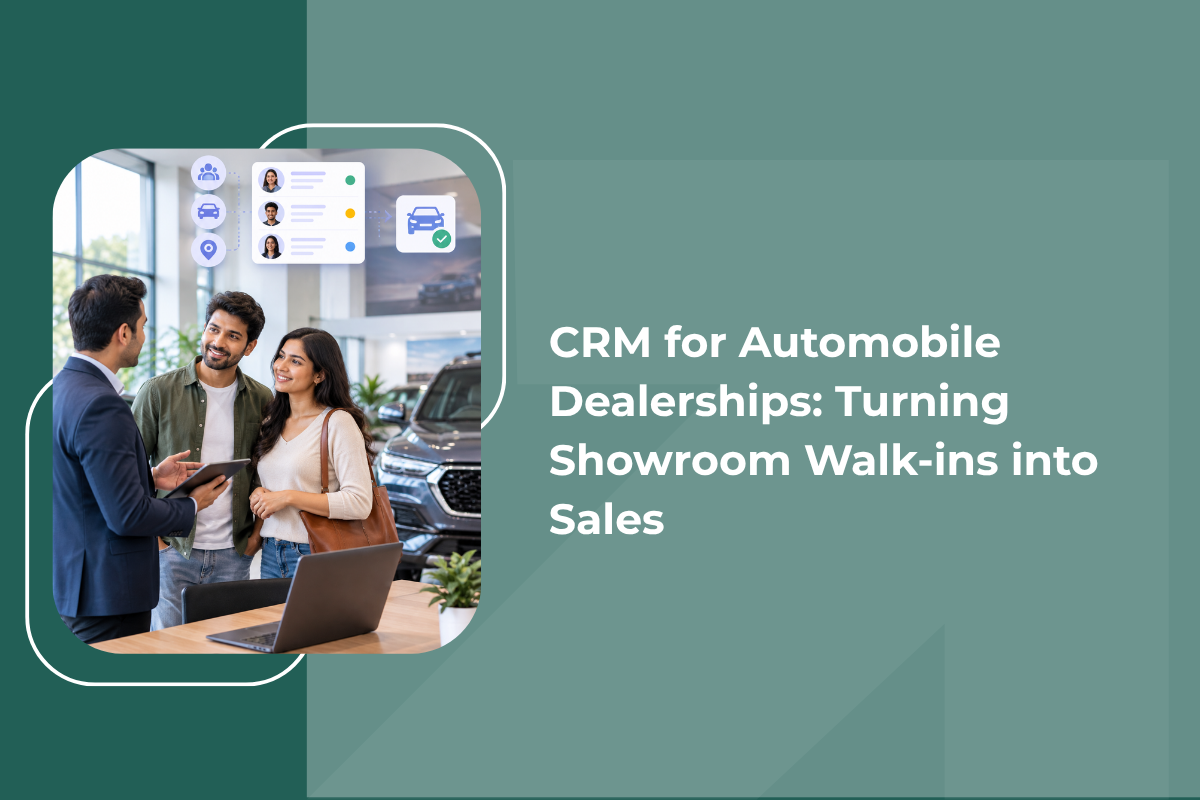
To thrive in today's demanding retail landscape, general managers and dealer principals must replace antiquated floor registers and chaotic manual processes with modern, data-driven systems. In this in-depth guide, we will unpack the foundational strategies for how to manage car dealership leads, examine the transformative impact of deploying a dealership CRM with WhatsApp, and explore how integrating specialized car dealership calling software turns showroom foot traffic into signed delivery contracts.
The True Cost of Showroom Floor Leakage
Every customer who walks into your showroom represents an investment. Between dealership facility leases, showroom architecture, prime retail positioning, print marketing, and performance marketing campaigns (Google Ads, Meta ads, localized social campaigns), the cost per showroom walk-in easily amounts to substantial sums.
When a sales executive fails to capture or follow up with a walk-in, the dealership suffers multiple compounding losses:
- Lost Front-End Gross Margin: The direct gross profit generated from the retail sale of the vehicle.
- Lost Back-End Finance and Insurance (F&I) Revenue: Vehicle loans, dealer financing arrangements, extended warranty packages, GAP insurance, and tire-and-wheel protection policies.
- Lost Trade-In Inventory: High-demand used vehicle inventory that could have been acquired during trade-in appraisal and reconditioned for high-margin pre-owned vehicle sales.
- Lost Long-Term Service Customer: The multi-year retention value derived from routine maintenance, spare parts, accident repairs, and customer accessories over the lifecycle of the vehicle.
A single lost customer represents tens of thousands of dollars in cumulative lifetime value lost to the dealership down the street. Fixing the leaky showroom bucket is the single most profitable operational initiative an automotive retailer can undertake.
The Breakdown: Why Auto Dealerships Lose Qualified Floor Leads
Before looking at solutions, it is essential to understand why dealerships consistently drop the ball when handling floor traffic. The showroom environment is dynamic, high-pressure, and chaotic. On busy weekends, sales executives bounce between vehicle demonstrations, trade-in valuations, price negotiations, and delivery ceremonies.
In this high-velocity atmosphere, lead management breaks down across four specific areas:
1. Reliance on Paper Logs and Business Cards
Many dealerships still rely on front-desk paper registers or physical visitor books. Visitors scribble down illegible phone numbers or incorrect names, and the register sits at the reception desk until the end of the day - or week - before being manually typed into an administrative spreadsheet. By the time a lead is assigned, days have elapsed.
2. The Follow-up Delay and Cold Outbound Calling
When sales consultants finally get around to following up, they rely exclusively on unannounced calls from the dealership landline or their personal mobile numbers. Modern car buyers rarely answer calls from unknown numbers during the workday. When the customer does not pick up, the consultant marks the lead as "unresponsive" and permanently moves on.
3. Disconnected Quotations and "Pencil Deals"
During showroom negotiations, consultants often jot down rough monthly EMI payments and discount figures on the back of a paper brochure or a blank sheet of paper. When the customer walks out with that sheet, the dealership retains zero copy or historical record of the numbers discussed. When the customer calls back days later, the sales team has no idea what was promised.
4. Zero Management Accountability
Dealer principals and general sales managers (GSMs) rarely possess real-time visibility into whether floor executives are completing their scheduled follow-up calls, which specific objections customers are raising, or how many test drives took place over the weekend. Without centralized monitoring, operational discipline collapses.
How to Manage Car Dealership Leads: The 6-Step Operational Playbook
Solving these issues requires implementing an agile, standardized methodology across the dealership. Here is the operational blueprint showing how to manage car dealership leads efficiently from the moment foot traffic arrives to the day the keys are handed over.
Step 1: Rapid Digital Intake at Reception
Eliminate paper logbooks entirely. Equip your showroom reception desk or host with a digital tablet connected directly to your management platform. Within twenty seconds of a guest arriving, the receptionist captures four critical data points:
- Customer Name and Verified Phone Number
- Vehicle Model and Fuel/Transmission Variant of Interest
- Current Vehicle Owned (Immediate Trade-in Evaluation Opportunity)
- Assigned Sales Consultant (via round-robin or customer preference)
Step 2: Immediate WhatsApp Welcome Automation
Before the sales consultant has even escorted the customer over to the showroom vehicle display, the prospect’s phone should ping with an automated WhatsApp message delivered via a dealership CRM with WhatsApp.
This instant message should include:
- A polite welcome message greeting them to the showroom.
- The digital brochure and high-resolution spec sheet for the model they came to see.
- A direct digital business card of their assigned sales executive.
This instant touchpoint establishes a modern, transparent customer experience and guarantees that the customer saves the sales executive's contact details in their phone.
Step 3: Digital Test Drive Documentation
The test drive is the single greatest catalyst for an automotive sale. A customer who takes a test drive is four times more likely to purchase than one who only inspects the display car.
The test drive process must be tracked inside your lead pipeline:
- Digital driver’s license capture for compliance and insurance.
- Specific demo car variant, fuel type, and transmission evaluated.
- Specific customer feedback recorded right after the drive: Did they like the acceleration? Did the spouse find the backseat spacious? Was boot space an issue?
Recording this feedback ensures that every future follow-up addresses the customer's actual personal priorities.
Step 4: Rapid Delivery of Digital Quotations
Within two hours of the customer exiting your dealership, the sales executive must dispatch a structured, transparent digital quotation via WhatsApp.
This should outline:
- Complete On-Road Price breakdown (Ex-showroom price, road tax, registration, insurance).
- Clear breakdown of current festive discounts or exchange bonuses.
- Customized financing options (Down payment options and prospective monthly EMI plans).
Sending this directly over WhatsApp ensures the customer has professional, easily readable documentation to review with their family members without dealing with confusing, unformatted text messages.
Step 5: A Structured Multi-Day Follow-Up Cadence
Follow-up is not a single event; it is an organized communication cadence. Because vehicle purchases involve financial deliberation, dealerships need a structured post-visit roadmap:
- Day 1 (24 Hours Post-Visit): Friendly follow-up call via car dealership calling software to ask how the customer enjoyed the driving experience and answer preliminary technical questions.
- Day 3: Educational content sent via WhatsApp: A short video link detailing safety ratings, warranty benefits, or advanced infotainment features of the vehicle.
- Day 5: Trade-in valuation follow-up: Sharing an attractive trade-in assessment for their current vehicle to reduce the perceived net cost of the new car.
- Day 7: Executive follow-up call: An invitation to take a secondary extended test drive or bring other family members into the showroom over the weekend.
- Day 14 – Day 30: Financing and urgency alerts: Updates on upcoming price revisions, limited inventory availability for desired color choices, or ending financing schemes.
Step 6: Post-Delivery Reviews and Service Onboarding
The lead management lifecycle does not conclude when the car leaves the delivery bay. Forty-eight hours after delivery, an automated message should check in on the driving experience, request a Google Maps dealership review, and share direct contact numbers for the service booking desk. Delighted buyers become lifelong referral engines.
Why a Dealership CRM with WhatsApp Outperforms Legacy Systems
In automotive sales, speed and convenience determine conversion rates. Traditional dealership software often forces sales consultants to communicate through slow, clunky email portals or unmonitored private phone calls.
Deploying a dedicated dealership CRM with WhatsApp transforms dealership performance in fundamental ways:
1. Sky-High Engagement and Open Rates
While promotional emails routinely sit unopened in spam folders with sub-20% open rates, WhatsApp messages boast open rates exceeding 95%, with the vast majority read within three minutes. When inventory is tight, or a limited-time manufacturer rebate is announced, WhatsApp ensures the offer is seen immediately.
2. Frictionless Media Sharing
Car buying is deeply visual. Sales executives can use WhatsApp to share:
- Short walk-around videos showing the exact color in direct sunlight.
- Walk-through clips highlighting interior lighting or boot space.
- PDF brochures, price lists, and financing matrices.
- Google Maps pin locations for test-drive pickup or showroom visits.
3. Total Centralization and Management Visibility
When sales consultants message prospects using personal WhatsApp apps, the dealership has no visibility into what is being promised. Price discounts could be quoted incorrectly, or customer complaints could be ignored.
A specialized automotive WhatsApp CRM brings all chats into a single, unified team inbox. Managers can oversee conversations, assist junior executives in real-time, and ensure that every customer interaction aligns with brand standards. If an employee leaves the company, customer chat histories remain securely preserved within the dealership database.
Accelerating Performance with Car Dealership Calling Software
While messaging is unmatched for sharing documents and maintaining ongoing rapport, vehicle deals are ultimately closed over the phone and across the negotiation table. However, handing sales executives a printed call sheet and expecting disciplined outbound calling fails every time.
Integrating purpose-built car dealership calling software transforms the productivity of both showroom floor teams and dedicated Business Development Centers (BDCs):
- One-Click Dialing (Click-to-Call): Executives initiate calls directly from their browser or mobile CRM interface with a single tap. Eliminating manual number dialing saves hours of administrative time each week and drastically increases daily outbound call volume.
- Intelligent Call Scheduling and Smart Reminders: When a prospective buyer says, "I am in a board meeting right now, please call me back tomorrow at 4:30 PM," the sales executive schedules an automated call task. At 4:30 PM sharp, the calling software automatically prompts the executive to dial, complete with prior notes on the screen.
- Automatic Call Recording & Quality Coaching: Every conversation can be recorded and archived against the customer's CRM profile. Sales managers can review call recordings during weekly training sessions to evaluate objection-handling techniques, verify financing pitch accuracy, and coach newer executives on closing strategies.
- Real-Time Call Analytics: General sales managers gain an instantaneous view of executive performance metrics: total calls placed, total connect time, appointments booked, and follow-up completion rates.
How GrowEasy CRM Empowers Automobile Dealerships
Automotive retail is fast-paced, and dealerships cannot afford complex, rigid software that requires months of technical onboarding and confuses showroom floor staff. Dealerships need an agile, intuitive sales platform designed for high-velocity teams.
This is where GrowEasy CRM provides automotive dealerships with a distinct competitive advantage:
- Unified Lead Ingestion: Centralize leads from Meta ads, Google Search campaigns, automotive listing portals, website inquiry forms, and showroom reception tablets into a single, real-time sales pipeline.
- Native WhatsApp Automation: Deploy a purpose-built dealership CRM with WhatsApp that triggers instant welcome messages, dispatches digital brochures, shares quotation PDFs, and facilitates two-way customer communication directly from a shared dashboard.
- Built-in Calling Engine: Equip sales consultants and BDC callers with modern car dealership calling software featuring click-to-call, automated call logging, call recording, and scheduled follow-up tasks that eliminate forgotten call-backs.
- Visual Dealership Pipelines: Track leads through transparent automotive sales stages: Walk-in Completed, Test Drive Done, Quotation Delivered, Financing In Review, Booking Confirmed, and Vehicle Delivered.
- Smart Follow-up Reminders & Notes: Ensure that every objection, preferred vehicle color, family preference, and trade-in detail is securely recorded, enabling any sales consultant or manager to resume negotiations seamlessly.
- Rapid Deployment: Unlike traditional automotive enterprise software that takes months to configure, GrowEasy CRM is designed for fast setup, allowing showroom sales teams to start closing leads within days.
Key Metrics Every Automotive Sales Manager Must Track
To ensure your showroom processes and lead management workflows deliver maximum profitability, track these six vital dealership KPIs inside your CRM dashboard:
| Dealership KPI | Industry Benchmark | What It Reveals About Your Dealership |
| Walk-in to Test Drive Ratio | 60% – 70% | Measures how effectively floor executives engage visitors and move them behind the wheel. |
| Test Drive to Booking Ratio | 25% – 35% | Reflects vehicle suitability, product knowledge, and executive negotiation capability. |
| Speed-to-First-Touch (Digital Leads) | Under 10 minutes | Direct predictor of conversion probability for website and social media ad leads. |
| Follow-up Compliance Rate | 90%+ | Percentage of scheduled follow-up calls and tasks completed on time by sales executives. |
| Average Deal Cycle Time | 7 – 18 days | The average duration from initial walk-in to final vehicle booking and delivery. |
| Outbound Connect Time per Rep | 45 – 60 mins/day | Quantifies actual customer voice engagement delivered by each sales advisor. |
Reviewing these metrics during morning sales huddles creates an environment of transparent accountability, healthy competition among executives, and relentless focus on pipeline health.
Turn Showroom Foot Traffic into Driving Customers
The showroom floor remains the most vital battleground in automotive retail. While digital discovery and online research have expanded, the decisive moment of purchase continues to take place on your dealership floor. Every visitor who walks through your showroom doors has invested their personal time and demonstrated genuine buying intent.
Allowing those high-intent opportunities to slip away due to forgotten follow-up calls, unorganized paper registers, or delayed quotations is an expensive mistake your dealership does not have to make.
By adopting a structured lead management process, communicating through an integrated dealership CRM with WhatsApp, empowering your team with specialized car dealership calling software, and leveraging the powerful capabilities of GrowEasy CRM, your dealership can eliminate lead leakage, maximize floor productivity, and consistently convert showroom walk-ins into proud new car owners driving off your delivery lot.