Table of Contents
Why the Site Visit Decides the Deal
Where Most Real Estate Leads Actually Get Lost
What a Real Estate CRM Actually Does for Site Visit Management
Building a Real Estate Lead Follow-Up System That Works
How CRM Helps Real Estate Sales Close More Deals
How to Manage Real Estate Leads in a CRM, Step by Step
A non-negotiable part of every real estate deal comes down to a single criterion: The site visit. No matter how convinced the client seems before the site visit, if it does not satisfy them, they will walk away. Even if the client seems unconvinced at the start, if the site visit process went well, the client will be convinced at the end. Hence, the result is: a smooth, well-planned visit can turn a curious lead into a booking within days.
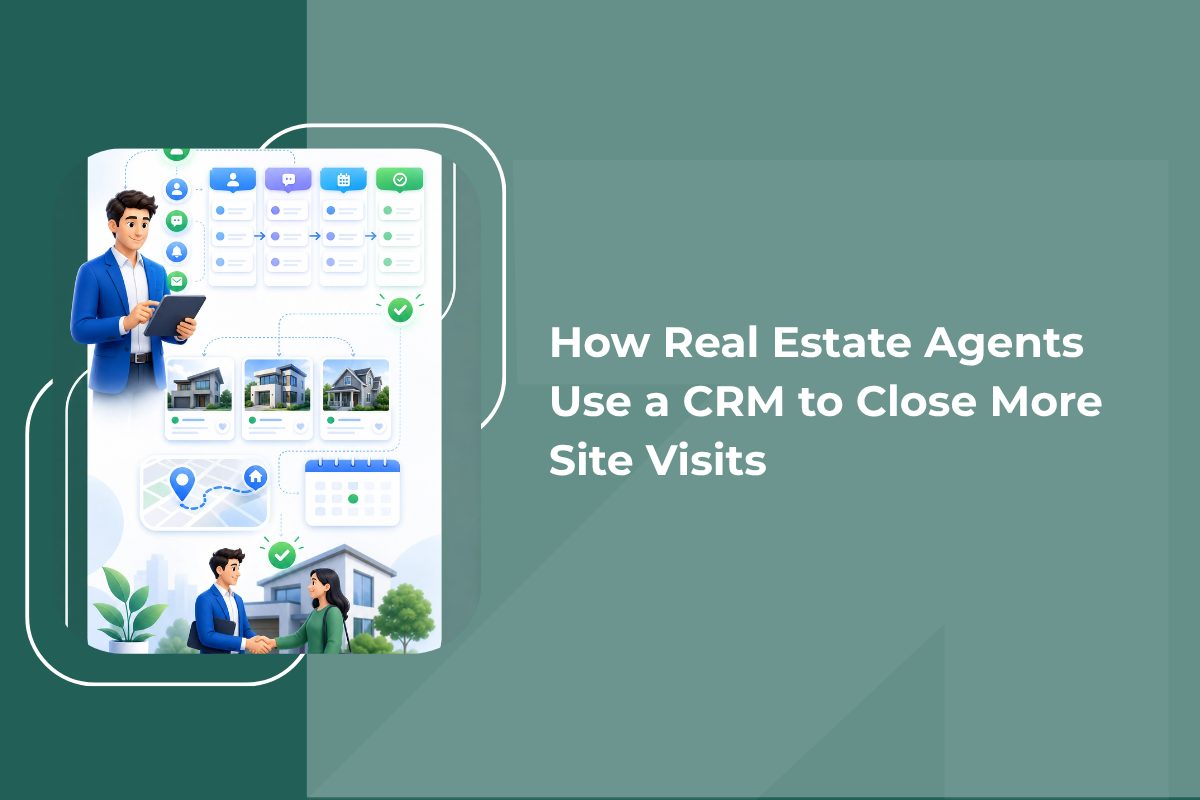
Yet most agents and brokerages still treat site visits as a scheduling afterthought, something jotted on a notepad or buried in a WhatsApp chat. The result is missed slots, forgotten follow-ups, and leads that go cold. This is exactly where a real estate CRM for site visits changes the game. It does not just store contact numbers; it manages the entire journey from first enquiry to final booking, making sure no visitor and no opportunity slip away.
In this blog, we will look at how real estate agents actually use a CRM to plan, track, and follow up on site visits, and why this single habit often separates agents who close consistently from those who are always chasing leads.
Why the Site Visit Decides the Deal
In a real estate sales process, marketing brings the enquiry, pre-sales qualifies the lead, but the site visit is where trust is actually built. It is the point where a prospect sees the property, imagines living or investing there, and decides whether to move forward.
Understanding who visits, where they came from, and what they are really looking for gives a business far better insight into audience behaviour. That insight is what strengthens every future pitch.
The problem is that a lot can go wrong before a visitor even reaches the gate. Two leads might get allotted the same time slot, a sales executive might forget to confirm a visit, or a prospect might arrive at a property that has not been prepared for their specific requirement, such as a two-bedroom unit with a balcony instead of a standard layout.
Every one of these small slips chips away at the first impression, and first impressions in real estate rarely get a second chance.
Where Most Real Estate Leads Actually Get Lost
Closing more deals is rarely about finding better buyers. It is about staying organised enough that no warm lead goes cold while an agent is busy with someone else. Most deal losses do not happen during negotiation; they happen in the gap between a buyer's first enquiry and the agent's first meaningful response.
A prospect messages at eleven in the morning, the agent is out on a visit, and by the time a callback happens in the afternoon, that same buyer has already spoken to two competing agents.
Speed and consistency of follow-up are two of the strongest predictors of real estate conversion. In a market where buyers are comparing several options at once, the agent who responds first and follows up most reliably usually wins, even if a competing listing is technically a better match.
Without a system in place, this speed depends entirely on one person's memory and availability on any given day. A CRM removes that dependency and makes fast, reliable follow-up the default behaviour of the entire team, not an occasional achievement of one motivated agent.
What a Real Estate CRM Actually Does for Site Visit Management
At its core, a CRM built for real estate site visit management gives a business much deeper insight into who is visiting a property, where they came from, how they heard about the project, and what their preferences are. That data does two things at once. It helps the marketing team refine targeting, and it helps the sales team prepare a visit that actually matches what the buyer wants to see.
A CRM addresses several practical challenges that agents face every single day. It manages scheduling so two leads are never allotted the same time slot, and follow-ups after a missed or postponed visit do not fall through the cracks. It helps front desk or reception staff identify a visitor instantly using their phone number or email, update their details with one click, and notify the concerned sales executive the moment the visitor arrives.
Many modern platforms also support self-serve check-in through a tablet or mobile app so that visitors can register themselves. At the same time, the system automatically queues them and alerts the right agent, cutting down wait time and creating a more professional experience from the very first minute.
This kind of visit tracking is not just about smoother logistics on the day. It becomes a lasting record. Every visit gets logged against the lead's profile, so the next time an agent picks up the phone, they already know which unit was shown, what objection was raised, and what the buyer asked for. That context alone makes every follow-up conversation feel more personal and more informed.
Building a Real Estate Lead Follow-Up System That Works
A real estate lead follow-up system is really just a structured way of making sure every lead moves forward instead of sitting idle. Instead of one long, undifferentiated list of contacts, a CRM organises leads into clear stages that reflect exactly where each buyer stands in their journey, for example, New Enquiry, Call Made, Site Visit Scheduled, Site Visit Done, Proposal Sent, Negotiation, Booking, and Closed.
With this structure in place, an agent opens their dashboard each morning and instantly sees which leads are closest to a decision, which ones have an overdue follow-up, and which ones need nurturing over the coming weeks. This alone solves one of the most common productivity drains in real estate sales, which is simply deciding what to work on next.
A buyer who visited yesterday and seemed ready to negotiate should never be treated with the same urgency as a cold enquiry from three weeks ago that has not responded to two calls.
Automated reminders are what actually keep this system running without constant manual effort.
Real estate buyers rarely decide after a single interaction; the typical journey includes several calls, a site visit, a round of negotiation, and a few reassurance touches before booking is confirmed.
When a lead moves to Site Visit Done, the CRM can automatically schedule the next follow-up two days later. When that date passes without action, the agent gets a reminder. When a lead has gone quiet for a week, the system flags it as overdue. The agent's job becomes acting on reminders rather than remembering to create them, which is a completely different and far less stressful way to work.
How CRM Helps Real Estate Sales Close More Deals
Beyond scheduling and reminders, there are a few specific ways a CRM helps real estate sales convert more consistently.
Every enquiry is captured automatically. Agents working across property portals, Facebook ads, referrals, WhatsApp, and website forms often lose leads simply because manual entry into a spreadsheet is unreliable during busy periods. A CRM connects directly to these channels so every enquiry flows into the pipeline tagged with its source and assigned to the right person without anyone copying data by hand.
Every conversation is remembered. Nothing damages a buyer's confidence faster than an agent who cannot recall what was discussed in the last call, whether it was budget, floor preference, or a specific objection. A CRM keeps a full timeline of calls, messages, site visits, and shared documents against every lead, so context is available before any interaction.
WhatsApp follow-ups happen without extra effort. Since WhatsApp is the primary channel between agents and Indian buyers, a CRM that integrates with it lets agents send messages directly from the same dashboard, with every message logged automatically. Template messages can even trigger on their own when a stage changes, such as a confirmation when a visit is booked or a gentle nudge after a proposal is sent.
Managers gain visibility without daily check-in calls. A manager can see exactly which leads each agent is handling, which follow-ups are overdue, and where deals are stalling in the pipeline, allowing them to step in before a deal is lost rather than after.
How to Manage Real Estate Leads in a CRM, Step by Step
Real Estate leads can be managed in the following step-by-step process:
- Efficient lead tracking: Monitor every stage of a buyer’s journey, from the first enquiry to the final sale, so no lead is overlooked, and follow-ups happen at the right time.
- Real-time updates and reminders: Keep agents informed about lead activity and upcoming tasks, helping them respond quickly and stay on top of every opportunity.
- Unified client communication: Manage emails, calls, texts, and site visit notes in one place, making it easier to keep communication organised and personalised.
- Automated follow-ups: Set reminders and automated messages for different stages of the buying process, ensuring clients receive timely communication even when agents are handling multiple leads.
- Performance analytics: Track conversion rates, response times, and lead source quality to identify gaps, understand what is working, and improve sales strategies using real data.
Choosing the Right CRM for Your Team
Not every CRM in the market is designed with real estate-specific realities in mind, such as high call volumes, site visit coordination, and the WhatsApp-heavy nature of Indian buyer communication. When evaluating options, look closely at how well a platform supports lead capture from multiple sources, visit scheduling, automated reminders, WhatsApp integration, and manager-level reporting, since these are the features that directly influence how quickly your team can respond and how consistently they follow up.
Grow Easy's real estate CRM is built around exactly this kind of workflow, with lead management, WhatsApp CRM, and mobile CRM working together so agents can manage enquiries and site visits from their phone while on the move, and managers get a clear, real-time view of the entire pipeline. If your team is currently relying on spreadsheets or personal phone numbers to manage buyers, it may be worth reading about why leads go cold and how to fix it, or exploring how to qualify leads faster before they reach the site visit stage.
Closing more real estate deals is almost never about working harder or chasing more leads. It is about building a process that keeps every visitor tracked, every follow-up timely, and every conversation informed by what came before it. A real estate CRM for site visits gives agents exactly that structure, turning a chaotic list of enquiries into an organised pipeline where the right lead gets the right attention at the right time.
The agents who consistently outperform their peers are rarely the ones working twice as hard. They are the ones using a system that keeps them focused on the leads closest to closing, follows up automatically when they are occupied elsewhere, and never lets a warm prospect slip away by accident. That is the real value of a proper real estate lead follow-up system, and it compounds with every single visit you manage well.
If you want to see how a purpose-built CRM can help your team manage site visits, automate follow-ups, and close more deals, explore Grow Easy's pricing and plans to find a setup that fits your brokerage.
Frequently Asked Questions
Does a real estate CRM only help large brokerages, or can smaller teams benefit too?
A CRM benefits teams of every size. A solo agent juggling twenty active leads faces the same problem as a large brokerage juggling two thousand, which is that memory and spreadsheets do not scale. Even a small team gains from automated reminders, a shared pipeline, and a single place to see which site visits are due, so the value of a CRM shows up early rather than only after a business grows large.
Can a CRM actually reduce the number of no-show site visits?
Yes, and this is one of the most immediate benefits agents notice. When a visit is booked, the CRM can trigger an automatic reminder to the buyer a day before and again a few hours before the scheduled time, along with directions or contact details for the sales executive. This simple nudge, combined with a confirmation call logged in the system, meaningfully cuts down on last-minute cancellations and wasted visit slots.
How long does it take a real estate team to get comfortable using a CRM?
Most agents pick up lead capture, pipeline stages, and reminders within the first week, since the interface mirrors how a sales team already thinks about its work. Full comfort with automation and reporting usually develops over three to four weeks of regular use, especially when a manager reviews the pipeline with the team during that early period.
What is the difference between a generic CRM and one built specifically for real estate?
A generic CRM can store contacts and set reminders. Still, it rarely understands the rhythm of a property sale, such as site visit scheduling, project-wise inventory, unit preferences, or the heavy reliance on WhatsApp for Indian buyers. A real estate-specific CRM builds these realities directly into its pipeline and automation rules, so agents spend less time customising the tool and more time using it to close deals.