Summary:
In 2026, Indian sales teams are leveraging WhatsApp's vast user base by focusing on strategies that emphasize customer consent, relevance, and timing. Effective WhatsApp marketing involves building consent-based lists, segmenting audiences, prioritizing utility messages, and using automation to enhance response times. AI-driven tools within a WhatsApp CRM can qualify leads and facilitate personalized interactions, while compliance with Meta's rules ensures message delivery and engagement. By integrating these strategies, businesses can maintain a strong presence on WhatsApp, fostering meaningful customer relationships and driving revenue growth.
Table of Contents
1. Build Your WhatsApp Marketing List With Customer Consent
2. Segment Before You Send Anything
3. Lead With Utility and Not Just Offers
4. Automate the Follow-Up, Not the Conversation
5. Let AI Qualify and Convert Inside the Chat
6. Get Your Templates Approved and Written Well
7. Respect Timing and Frequency
8. Choose a WhatsApp CRM Carefully
India is WhatsApp's largest market. Meta has publicly stated the country has crossed 500 million users, and for most Indian sales teams, this small piece of information means one simple thing: your leads are already on WhatsApp, several times a day, without you needing to convince them to install anything.
The challenge is that almost every business has figured this out. Inboxes are more crowded, Meta has tightened its enforcement, and tactics that worked three years ago can now get your number restricted or banned. So what WhatsApp marketing strategies still work in 2026?
Below are the strategies Indian sales teams are actually seeing results from in 2026, built around permission, relevance and timing, and a CRM that keeps every conversation tied to a lead, rather than volume.
1. Build Your WhatsApp Marketing List With Customer Consent
Every effective WhatsApp marketing strategy starts with a list that you made.
The channels that work best in India are a Click to WhatsApp ad on Facebook or Instagram, a chat button on your website, a QR code at your billing counter, and a checkbox during checkout. Each of these captures someone who chose to hear from you, which is exactly what Meta wants to see and what India's Digital Personal Data Protection Rules, notified in November 2025, will require as compliance deadlines approach.
Click-to-WhatsApp ads deserve special attention because they collapse the gap between interest and conversation. Someone taps your ad and lands directly in a chat instead of a form, and if that ad is connected to a lead management system, the conversation is already sitting against a lead record before your team even sees it.
2. Segment Before You Send Anything
The fastest way to damage a WhatsApp list is to send everything to everyone. Relevance drives engagement far more reliably than reach does.
Practical segments for an Indian sales team are straightforward. Split by lead stage, by city, by funnel stage, and by engagement level. A lead who enquired last week needs a different message from someone who was marked cold in March and went quiet, which is exactly the kind of segmentation a CRM's lead scoring does automatically instead of you sorting a spreadsheet by hand.
One segment Indian businesses consistently underuse is language. WhatsApp supports major Indian languages such as Hindi, Tamil, Telugu, Gujarati, Marathi, Bengali, Kannada, and Malayalam. Using the language your customers are most comfortable with can make your outreach feel more personal, relevant, and familiar. For example, a Surat jeweller writing in Gujarati is playing on home ground.
Segmentation also protects your account. Smaller, better-matched sends produce fewer blocks, which keeps your quality rating green and your daily limits climbing.
3. Lead With Utility and Not Just Offers
This is the strategy most sales teams skip, and it's the one with the clearest financial logic.
Meta charges by message category. In India, marketing messages cost roughly ₹0.8631 each while utility messages cost around ₹0.1150. That's close to a sevenfold difference for the same delivery.
More importantly, utility messages get read. An order confirmation, delivery update, appointment reminder or payment receipt is something the customer wants. Send those consistently through your WhatsApp CRM, and your promotional messages later land on a relationship rather than a cold contact.
A useful ratio to aim for is roughly four genuinely helpful messages for every single promotional one you send.
4. Automate the Follow-Up, Not the Conversation
Most Indian sales teams lose deals in the gap between enquiry and reply. The lead messages at 9pm, your team responds at 11am the next day, and by then they've called someone else.
Automation fixes the timing problem without making you sound robotic. CRM automation can build an instant acknowledgement for new enquiries, a reminder sequence for demos and appointments, a recovery flow for stalled leads, and a reactivation campaign for contacts who've gone quiet.
The key is handing over to a human at the right moment. Automation should qualify and hold attention, then step aside for your rep once the lead is warm.
5. Let AI Qualify and Convert Inside the Chat
WhatsApp is no longer just a notification channel. With AI running inside your WhatsApp CRM, a lead's first reply can be read, understood, and acted on before a human ever sees it, answering a question, sharing a brochure, or booking a site visit directly in the conversation.
This matters enormously in India, where a lot of buying still involves negotiation, clarification and a bit of back and forth before someone commits. A landing page can't do that. A chat, backed by AI that logs everything straight into your pipeline, can.
6. Get Your Templates Approved and Written Well
Every promotional message goes out as a template that Meta reviews. Rejections usually come from vague variable placement, promotional language dressed up as a utility message, or missing context.
Beyond approval, good templates share a few traits:
- They open with something specific to that customer.
- They carry one clear idea rather than three.
- They use a button such as Reply, Call, Buy or Book instead of asking people to type.
- They close with an easy opt-out line.
Keep messages short. People scan WhatsApp far faster than email. A WhatsApp CRM with ready-made templates for first touch, follow-up, confirmation and re-engagement removes most of the guesswork here.
7. Respect Timing and Frequency
A WhatsApp marketing campaign sent at the wrong hour feels intrusive in a way email never does, because the phone buzzes in someone's pocket.
For most Indian consumer businesses, late morning and early evening on weekdays perform reliably. B2B audiences respond better during working hours. Test against your own data rather than trusting a generic benchmark, because a jewellery buyer in Surat and a SaaS founder in Bengaluru behave nothing alike.
India's festive calendar deserves a plan of its own. Navratri, Dussehra, Diwali, Eid, Onam and Rakhi concentrate a large share of annual buying intent into a few predictable weeks. Build your templates and offers in advance so approval delays never cost you the moment.
On frequency, less is genuinely more. Meta applies its own capping to limit how many marketing messages a person receives daily across all brands, so flooding your list doesn't even reach everyone. One well-planned campaign a week usually beats four rushed ones.
8. Choose a WhatsApp CRM Carefully
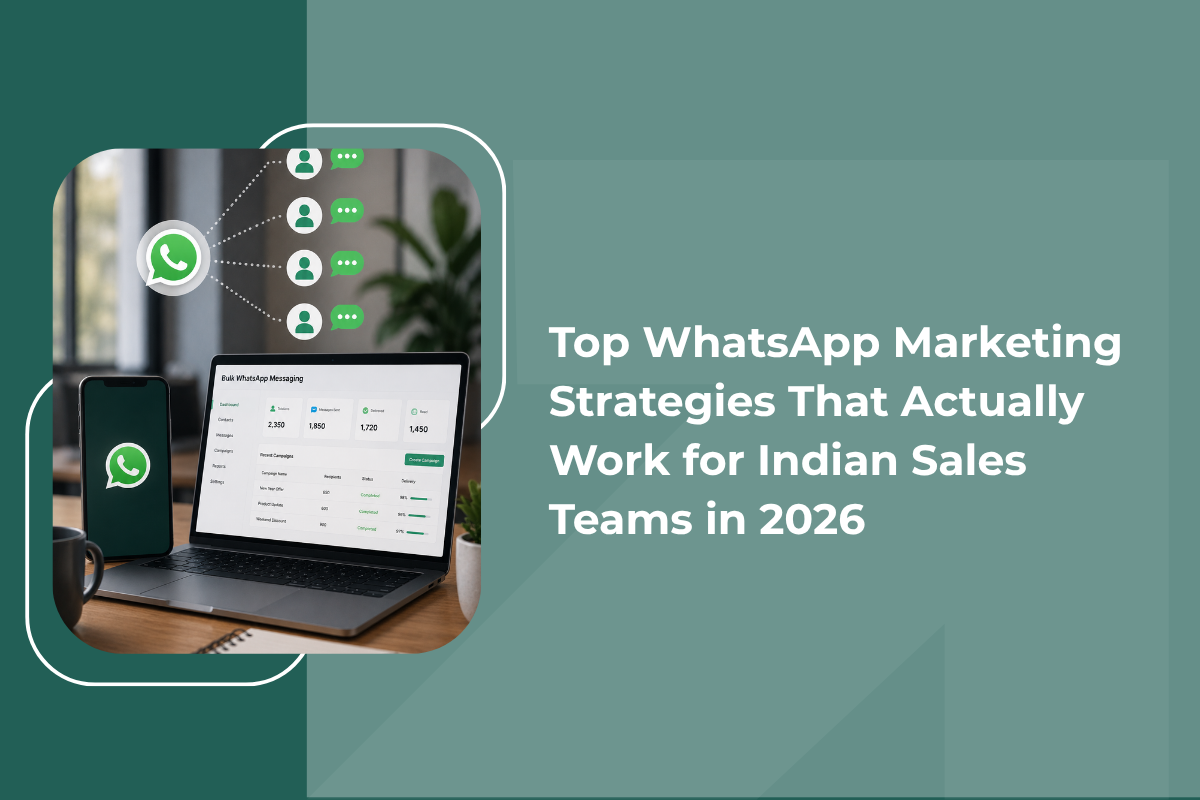
The platform you pick determines whether all of the above is easy or exhausting. Any credible WhatsApp CRM should run on the official Meta Cloud API, handle CSV uploads with automatic number verification, support dynamic personalisation, manage template submission, offer real-time delivery and reply analytics, log every conversation against a lead record, and price transparently.
Be cautious with anything advertising unlimited free sending. Those tools typically automate WhatsApp Web, which violates Meta's terms and puts your number at direct risk. See our CRM comparison page for how official platforms stack up against risky workarounds.
9. Measure What Actually Predicts Revenue
Here are the outcomes you should measure to predict your revenue:
- Delivery rate tells you your list is clean.
- Read rate tells you your timing and sender name are working.
- Reply rate tells you your message was relevant.
- Click rate tells you your offer landed.
- Opt-out rate is your early warning system.
- Quality rating is the score Meta uses to decide your limits.
Watch opt-out rate most closely. A rising number there is the clearest signal that your frequency or relevance has slipped, and it shows up well before a ban does. Real-time AI analytics inside your CRM makes this easy to catch before it becomes a problem.
10. Treat Compliance as a Growth Asset
It's tempting to see Meta's rules as obstacles. In practice, they're what keeps WhatsApp valuable. Because spam is aggressively policed, your messages still get opened.
Keep documented consent, honour every opt-out immediately, use approved templates, and monitor your quality rating in WhatsApp Manager. Those four habits protect the channel that protects your revenue.
The Indian sales teams winning on WhatsApp in 2026 are not the ones sending the most messages. They're the ones who collect consent honestly, segment properly, lead with useful information, automate their follow-up, and stay well inside Meta's rules, all from one dashboard that ties every conversation back to the deal.
GrowEasy CRM brings those pieces together on the official Meta Cloud API, with CSV bulk broadcasting, approved templates, dynamic personalisation, AI-qualified replies, automated follow-ups, and real-time analytics, plus telecalling and lead management built into the same platform. Plans start at ₹999/month with the WhatsApp API included; see the details on our pricing page.
Pick two strategies from this list, run them properly for a month, and measure honestly. That always beats attempting all ten badly. Book a free demo and build your first campaign this week.