Summary:
A CRM, or Customer Relationship Management system, is essential for growing sales teams as it organizes and manages customer interactions, streamlining processes from initial contact to final sale. It addresses common challenges like forgotten leads and duplicate efforts, providing features such as lead management, pipeline visibility, and automated follow-up reminders. By enhancing response times and offering clear insights into sales activities, a CRM helps teams improve efficiency and increase revenue, making it invaluable even for smaller teams. Choosing the right CRM involves ensuring it aligns with team needs and is user-friendly, ultimately transforming sales operations.
Table of Contents
If you are running a sales team that has outgrown sticky notes, spreadsheets, and scattered WhatsApp chats, you've probably heard the word "CRM" thrown around a dozen times. But what does it actually mean, and why does every growing sales team seem to need one?
This confusion is fair. On paper, a CRM sounds like just another piece of software. In practice, it ends up being the single most important tool a sales team uses every day, more important, in many cases, than the phone or the email inbox itself.
Let's break it down in plain language.
What Is a CRM?
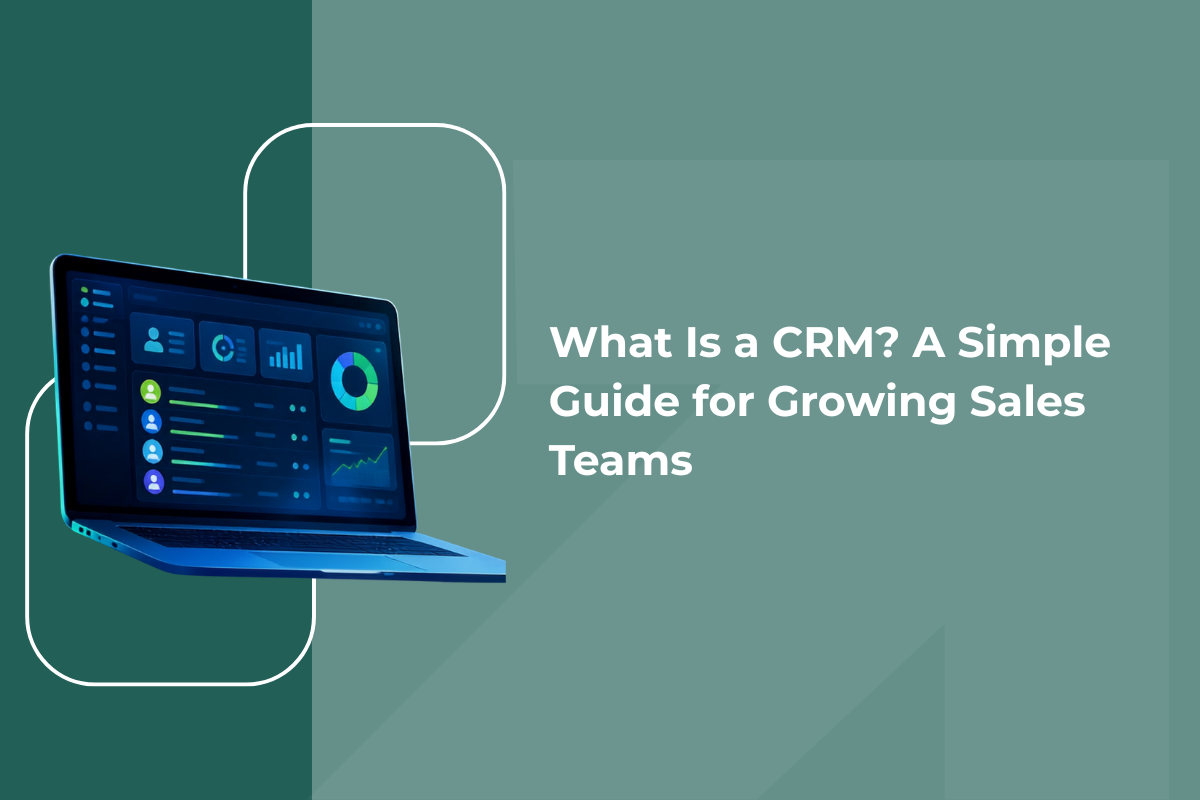
CRM stands for Customer Relationship Management. At its core, a CRM is a system that helps you organize, track, and manage every interaction you have with leads and customers, from the first inquiry to the final sale, and everything after.
Think of it as a single source of truth for your sales process. Instead of digging through emails, call logs, and random notes to remember where a deal stands, a CRM keeps everything in one place: contact details, conversation history, deal stage, follow-up reminders, and more.
For growing sales teams specifically, a Sales CRM Software is not just a contact book, it is the backbone that keeps the entire sales process moving without leads slipping through the cracks.
At a basic level, every CRM is trying to answer three questions your sales manager asks every single day: Who are our leads? What stage is each one at? And who is responsible for the next action? Once a system can answer those three questions reliably, everything else, reporting, automation, forecasting, builds on top of it.
Why Growing Sales Teams Struggle Without One
When a sales team is small, say two or three people, it is fairly easy to keep track of leads manually. A spreadsheet, a notebook, or even memory can get the job done.
But growth changes everything. As soon as you add more salespeople, more leads, and more sources (website forms, ads, referrals, walk-ins), a few problems show up almost immediately:
- Leads get forgotten or followed up with too late
- Two team members accidentally contact the same lead
- Managers have no clear visibility into what is actually happening in the pipeline
- Historical conversation context gets lost when a salesperson leaves
- Reporting becomes a manual, error-prone task at the end of every month
This is exactly the gap a CRM is built to close.
Core Features of a Good Sales CRM Software
Not all CRMs are built the same, but most solid sales crm systems share a few essential capabilities:
1. Lead and Contact Management - Every lead captured through your Lead Management Software and every customer detail stored in your Contact Management Software live in one searchable place, no more hunting through old chats or forgotten spreadsheets
2. Pipeline Visibility - A clear, visual view of where every deal stands, new, contacted, negotiating, closed, so nothing gets stuck without anyone noticing.
3. Automated Follow-Up Reminders - Instead of relying on memory, CRM Automation Software nudges your team when a lead needs a follow-up call, email, or message.
4. Reporting and Analytics - Real-time insight into team performance, conversion rates, and where deals tend to fall through, without building manual reports every week.
5. Team Collaboration - Managers and teammates can see notes, call history, and next steps on any lead, so work continues smoothly even if someone is on leave or switches roles.
Is a CRM Only for Big Companies?
This is one of the biggest misconceptions out there. In reality, a good sales crm can be even more valuable than for a large enterprise, simply because small and growing teams can not afford to lose leads or waste time on manual admin work.
A small team using the right CRM tools can:
- Respond to leads faster than competitors relying on spreadsheets
- Make sure every enquiry gets a timely follow-up
- Avoid duplicate work between team members
- Get a clear picture of what is working and what is not, without a dedicated analyst
In other words, a CRM helps a small, lean team punch above its weight.
Signs Your Team Has Outgrown Manual Tracking
Not sure if it is time to move on from spreadsheets? Here are a few common signs:
- You've lost track of a lead's last conversation more than once
- Your team spends more time updating sheets than actually selling
- Leads are coming in from multiple channels and nobody owns the full picture
- Your manager has to ask "what is the status of this lead?" instead of just checking a dashboard
- Follow-ups are missed because there's no automatic reminder system
If two or more of these sound familiar, it is a strong signal that manual tracking is now costing you deals rather than saving you money.
Choosing the Right CRM Tools for Your Team
When you start evaluating sales crm tools, it helps to focus on what your team actually needs rather than the longest feature list. A few practical questions to ask:
- Is it simple enough that your team will actually use it daily?
- Does it fit your sales process, or will you have to change your process to fit the software?
- Can it grow with you as your team and lead volume increase?
- Does it offer mobile access for salespeople who are out in the field or on calls constantly?
- Is customer support responsive when something goes wrong?
The best CRM is not necessarily the one with the most features, it is the one your team will actually open every single day.
Common Myths About CRMs
Before wrapping up, it is worth clearing up a few misconceptions that often stop teams from adopting a CRM sooner than they should.
"A CRM is just a fancy spreadsheet." A spreadsheet stores data. A CRM acts on it, sending reminders, tracking activity automatically, and giving a live view of the pipeline without anyone manually updating a cell.
"Our team is too small to need one." As covered above, smaller teams often benefit the most, since every single lead matters more when volume is lower.
"it will slow my team down with extra data entry." A well-chosen CRM should reduce admin work, not add to it. If a tool constantly demands manual entry with no automation in return, it is usually the wrong tool, not proof that CRMs in general are a burden.
"We'll set it up later once we are bigger." The later a team adopts a CRM, the more historical data, habits, and disorganized processes need to be untangled first. Adopting one early, even with a small team, sets a clean foundation to scale from.
The Real Impact on Revenue
The value of a CRM is not just organizational, it shows up directly in numbers. Teams that respond to leads within the first few minutes convert significantly better than those who follow up hours or days later. A CRM makes fast response possible by instantly notifying the right salesperson the moment a new lead comes in.
Beyond speed, visibility matters just as much. When a manager can see exactly how many leads are stuck, how long deals sit untouched, and which salesperson is converting best, coaching and forecasting become far more accurate than relying on gut feeling at the end of the month.
Over time, this combination, faster response, better visibility, and consistent follow-up, compounds into a measurable difference in closed deals, even with the same lead volume and the same team size.
Final Thoughts
A CRM is not just software, it is a shift in how a sales team operates. It replaces guesswork with visibility, replaces scattered notes with a single organized system, and replaces missed follow-ups with timely reminders.
If your team is growing and you are starting to feel the cracks of manual tracking, it might be time to explore a proper Sales CRM Software built for exactly this stage of growth.